– “…From the prison industry, to the pharmaceutical industry, to the timber industry, billions of dollars are being thrown at the failing marijuana war in an attempt to maintain the facade of a evil drug that will corrupt your children and ruin your life. This however is a remanent of a time before the internet; a time when the government could be caught in a lie and there was time to secretly hide the evidence. That time has come to an end”:
(10 Myths About Marijuana That No-One Should Believe & Why – By Ryan Cristián)
According to a recent report by the Drug Enforcement Administration (DEA), 80% of states have legalized some form of medical marijuana, and 23 have broadly legalized marijuana use for medical purposes. Four of those states, along with the District of Columbia, have also legalized marijuana for recreational use. This is the will of the people coming to fruition, despite the overwhelming obstacles set in place by the very government meant to fight for that will.
Children’s lives have been saved, cancers fought off, and more everyday are rescuing their lives from a debilitating illness due to the medical efficacy of cannabis. Yet, the opposition would have Americans see these grateful citizens as dangerous drug using criminals that are breaking the law. In the eyes of the anti-marijuana campaign, these stories of triumph over sickness are counted as a loss in the war on marijuana. There is no denying the influence this movement has had on the perception of cannabis and civil rights across the world. However, many still cling to lies that any rational minded person would have cast aside. The following are the top ten myths that a rational, open-minded and intelligent person should no longer believe; based on cold hard evidence and scientific discovery.
MYTH #1 – MARIJUANA IS MORE HARMFUL THAN CIGARETTES, ALCOHOL AND PRESCRIPTION DRUGS
The most important thing to point out when discussing this topic is that anything is harmful in excess. If one chooses to eat a pound of salt they would die, which is actually true. That does not make salt itself dangerous, rather the danger lies in the excessive use. Cannabis consumed in excess will have its negative effects like anything else, however the fact remains that no one has ever died from cannabis use, ever. Some will continue to shrug that statement off as a fabrication, but these articles are for those who put their faith in facts, not in preconceived prejudice.
Cigarettes – It is hard to believe that anyone would argue that cigarettes are safer than cannabis yet many sites with obvious and specific agendas continue to lie to the public. Every year almost half a million people die due to cigarettes. According to the CDC, there is an estimated 5.5 million YPLL (years of potential life lost) every year in this country due to cigarettes, and this does not include second-hand smoke. If a rational mind was to make a judgement call based on the afore-mentioned science and indisputable facts, cigarettes are quite obviously more harmful than cannabis.
Alcohol – Alcohol has become so ingrained in everyday society that the public chooses not to see it as the dangerous drug that it truly is. Many scientists believe that alcohol is more dangerous than the entirety of the Schedule I listing. Professor David Nutt was fired for even speaking the words, despite the irrefutable results proving his theory correct. In the U.S. approximately 50,000 cases of alcohol poisoning are reported annually. One patient dies each week in the U.S. from said poisoning. When compared to the zero overall death toll attributed to marijuana, it is clear that alcohol is a far more dangerous substance.
“Alcohol is the drug that is involved in more murders than any other drug on planet earth.” – Howard Bloom, expert on mass behavior.
Prescription Drugs – The most ridiculous hypocrisy is that of prescription drugs, which are resting comfortably in Schedules II, III and IV which allows them to be sold to the public by our very own government. According to the Journal of the American Medical Association, over 100,000 deaths are caused annually due to prescription drugs. The CDC states that prescription drugs are the fastest growing cause of death in this country, naming the issue an “Epidemic.” Two-hundred and ninety people in the United States are killed by prescription drugs every day. That’s one American death every 20 minutes and yet these drugs are actively given out to adults and youth alike. According to KVTX 19, In 2010 doctors prescribed enough painkillers to give a 45mg percocet and 24 5mg vicodins to every person in the United States. With such a rising death toll, one would think the FDA would reevaluate the dangers of overdose and addiction associated with these dangerous drugs, yet prescriptions continue to rise day-to-day.
Related Reading: Avoiding A Cure: How Big Pharma And The DEA Collude To Control Your Health
The fact that most marijuana opposition campaigns are almost fully funded by pharmaceutical companies is a tightly guarded secret known only to those concerned enough to unearth the deeply rooted conflict of interest buried at its core. This fact is only just beginning to come into light for the masses.
One should ask themselves why these billion dollar companies would waste money to fund an anti-marijuana campaign. The answer is simple: Cannabis scares them. The sad fact is that there is no money in curing, only in treating. These companies fear a medicine that cures and can be grown in one’s back yard. According to the British Medical Journal, every 1 dollar that pharmaceutical companies spend on research and development, they spend 19 dollars on promotion and marketing of their drugs. Their focus is not on what is most helpful to the public, but rather what is the most profitable. These companies are legalized drug dealers, nothing more, and yet marijuana, which has never taken a life, is illegal.
“The number of people killed each year by heroine and cocaine is tiny, TINY, just minuscule, microscopic, compared to the number killed each year by prescription drugs.” – Graham Hancock, Writer, Journalist
MYTH #2 – MARIJUANA IS HIGHLY ADDICTIVE

One of the longest standing myths about marijuana, that still continues to find its way into political debate, is the claim that the substance is highly addictive; thus explaining the Schedule I placement, or so the government would have the public believe. This is the most frequently cited perceived harm associated with marijuana today.
Can marijuana be addictive, yes, but in order to understand addiction in relation to marijuana, one must first have an understanding of the psychology behind addiction in the first place.
“People can have sex without being addicted to it, they can go shopping, but some people become seriously addicted to all these pursuits. Is a pack of cards addictive? Well no or yes depending on the individual. So it’s the same process no matter what the addiction. The only difference really is whether the substance addict is getting his dopamine from an outside substance or the behavior addict is having it triggered by outside behavior. The person that occasionally smokes marijuana, but generally has no negative consequences, it does not impair their health, it does not endanger their lives, it does not impair their personal relationship, you can’t call these people addicts and you can’t call those behaviors addictive.” – Dr. Gabor Maté, Addiction Specialist, “The Culture High”
Marijuana can be addictive in the way that anything or any action can become an addiction, and that is psychologically. There have been some recent studies that show even that type of addiction is relatively rare, having a rate of only 9% of users who regularly use cannabis. This major distinction between a chemical and a psychological addiction is abused in a political fashion to manipulate the masses who do not understand the difference. One can become psychologically addicted to anything that is abused, but that does not make everything addictive, especially not enough to be added to the Controlled Substance Listing.
A chemical addiction is one that produces the widely known physical effects of withdrawal. The body adapts to the drug, requiring more of it to achieve a certain effect (tolerance) and eliciting drug-specific physical symptoms if drug use is abruptly ceased. This is the form of addiction that the Controlled Substance List was created to impede. In comparison to physical addiction, psychological addiction occurs when a person does not have a physical need for a drug but rather a mental desire for it. There is a fundamental difference between the two that is widely disregarded when discussing the “addictive” properties of cannabis. In most cases one can be addicted to cannabis in the same fashion that one can be addicted to jogging. Obsession is not the same as addiction, especially when determining a possible restriction on that basis. The intention is not to diminish the very real effects of a psychological addiction, of which there are many, rather to demonstrate the game of misdirection used to maintain the placement of cannabis on a restrictive listing.
There have been recent studies that show some minor withdrawal symptoms associated with long-term, everyday cannabis consumers suggesting a very small percentage of chronic users do develop a chemical, albeit minor, addiction. These symptoms were relatively mild, elevated pulse, irritability and headaches, when compared to even the lowest level opiate (Schedule II). It is important to understand that these were the only negative withdrawal symptoms from a lifetime of cannabis use. One could hardly consider this withdrawal, being less intrusive than a caffeine addiction. An everyday, long-term opiate user would have an extreme and possibly deadly withdrawal.
To put that in perspective, cannabis is on the Schedule I Controlled Substance List, which is the home of the most highly “chemically addictive” drugs such as heroin, LSD and mescaline. Topping the Schedule II listing is Codeine, or opiates, which are indisputably the fastest rising addiction problem in the U.S. yet they are in a lower risk category than cannabis which has the lowest recorded addiction of all the drugs in any Schedule. One in four who use heroin will become chemically addicted. One in every three who smoke cigarettes will become chemically addicted, yet tobacco, which has a higher death and addiction rate than any of the controlled substance, is freely available. Even caffeine, one of the most commonly used drugs in this country, has a higher rate of addiction and withdrawal than that of the demonized enemy number one, marijuana.
A new study suggests that one can feel serious withdrawal symptoms from abstaining from something as common place as junk food. According to a study published by Dr. Stephanie Fulton of the University of Montreal’s Faculty of Medicine a heavy consumer of fatty foods can feel symptoms like that of an addiction withdrawal, such as anxiety and depression, when beginning a diet. Based on the government’s usually broad understanding of addiction, and the logical association of the symptoms, junk food might be next in line to join the arbitrary Schedule I listing. Do not fret junk food lovers, there is far too high a profit and demand for this country’s beloved fast-food, for it to ever be restricted.
“I’ve got a friend whose aunt had to go to rehab for buying two boxes of Krispy Kreme every day and eating them in the woods so nobody found her, based on that anecdote we should make Krispy Kreme illegal, I will fight any man, by the way, that suggests that.” – Rufus Hound – Comedian/Actor
There are a multitude of reasons one can become psychologically addicted to a substance or an action, yet one can not definitively label these as addictive or dangerous for the majority. Especially in the case of cannabis which contains so many valuable uses and byproducts. Cannabis can certainly have adverse effects on a person choosing to use the substance in excess, especially as a child with a developing brain, however all the facts make it quite obviously mis-represented in the current Schedule I listing. Is it potentially harmful in excessive circumstances? Like most things, absolutely. Is it highly addictive, definitively not.
Related reading: Prescription Painkillers: A Gateway Drug to Heroin Addiction
MYTH #3 – MARIJUANA CAUSES SCHIZOPHRENIA
 One of the newest concerns about marijuana that has been gaining attention in the media recently is the worry that its consumption causes schizophrenia. This serious affliction is a mental disorder that makes it hard to differentiate between what’s real and what’s not, think clearly or have normal emotional responses. This has become one of the last clinging defenses for marijuana prohibitionists, claiming that marijuana makes you literally go crazy.
The idea that marijuana is the sole cause of this illness with no other factors involved is a claim made primarily by sensationalists and those who do not fully understand how the illness works.
“My first seven years of research were devoted to schizophrenia and I can tell you that [the idea that marijuana can cause schizophrenia] is ridiculous.” Dr. Lester Grinspoon
Inheriting genes from both parents is a legacy of issues and benefits that none can avoid. Scientists have long known that schizophrenia is inherited genetically. The illness naturally occurs in a small percentage of the general population with a predisposition for the disease. It has a higher rate of 10 percent occurrence in those who have a first-degree family member with the ailment, such as a parent, brother or sister. The risk is highest for an identical twin of a person with schizophrenia. He or she has a 40 to 65 percent chance of developing the disorder.
After reviewing this common scientific knowledge, the reality of the true cause is clearly shown. It is genetically impossible for marijuana use to cause schizophrenia in a person that did not already have the inherit genes necessary to trigger the ailment. Which means that marijuana can not be the cause in and of itself. This by itself debunks the continually stated misunderstood theory that cannabis use alone causes schizophrenia. That being said, the secondary theory is that marijuana is simply the catalyst, causing the illness to trigger in those already predisposed, which is a plausible if not reasonable assumption.
“While cannabis may have an effect on the age of onset of schizophrenia it is unlikely to be the cause of illness,” said the researchers, who were led by Ashley C. Proal from Harvard Medical School.
It is important to understand that there are many psychological and physical events that can trigger this disease. Being the catalyst or trigger of schizophrenia is not an implication of the dangers of that action or substance. This illness can be triggered by a serious car accident but that does not mean that driving should be made illegal. Heavy alcohol or tobacco use has been known to be a trigger as well as many others. Even serious emotional trauma can awaken the dormant gene. Whatever the catalyst, the gene itself is already present in a person who might one day suffer its effects and can not alone be attributed to any outside influence.
“We looked at the evidence, and I think we must have gone through about two thousand papers, and [marijuana] doesn’t cause schizophrenia, maybe there are some individuals with schizophrenia in which the illness is brought on perhaps a little earlier because they smoke cannabis.” Prof. David Nutt – “The Culture High”
There is an undeniable correlation between those who use cannabis and those with schizophrenia, however, a Harvard Medical study as well as many others, show that those with the gene for schizophrenia have a genetic predisposition for drug use. Seeing as how marijuana is the most common drug of choice and roughly 60% of the U.S. has smoked marijuana at some point in their lives, it becomes an easy statistic to show that the vast majority of those with schizophrenia are also marijuana smokers. One could show a direct correlation between marijuana smokers and just about anything due to the rising percentage of those who have smoked marijuana in this country. Using that same logic, one could show a direct correlation between cannabis use and the flu. There would no doubt be a large percentage of people who had previously gotten the flu, and had also smoked marijuana, simply due to the prevalence of marijuana use today. This however, does not mean that marijuana use causes the flu. This is one way that polls and statistics can be quite misleading.
The fact is that schizophrenia has a prevalence of about 1% the world around. If in fact cannabis was the direct cause or even the triggering component, there would be a corresponding rise in the occurrence of the illness along with the rise of cannabis use. Since the sixties, cannabis has rapidly increased in use and has seen a dramatic increase with the recently growing legalization movement. Yet the prevalence of the disease remains at 1%. This more so than any other graph, poll or statistic shows how the increase in marijuana use over the last fifty years has had literally zero effect on the country’s occurrence of schizophrenia. In other words, myth – debunked.
Related reading: The Fictions Surrounding the “Chemical Imbalance” Theory of Mental Illness
MYTH #4 – MARIJUANA HAS NO PROVEN MEDICAL BENEFITS
“We have been terribly and systematically misled for nearly 70 years in the United States… marijuana was a legitimate medication.” Dr. Sanjay Gupta
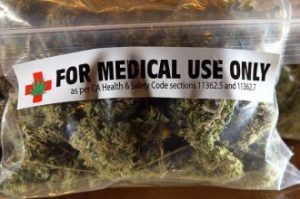
For more than 5000 years cannabis had been effectively used in Traditional Chinese medicine (TCM). Cannabis is one of the 50 “fundamental” herbs of TCM, and is still prescribed today to treat a variety of symptoms. Up until the early 1900’s, cannabis and hemp were used in just about every aspect of American life, from fuel to rope, and most importantly, medicine. It was not until certain industries became threatened by cannabis that it was selfishly and unjustly branded as a dangerous substance.
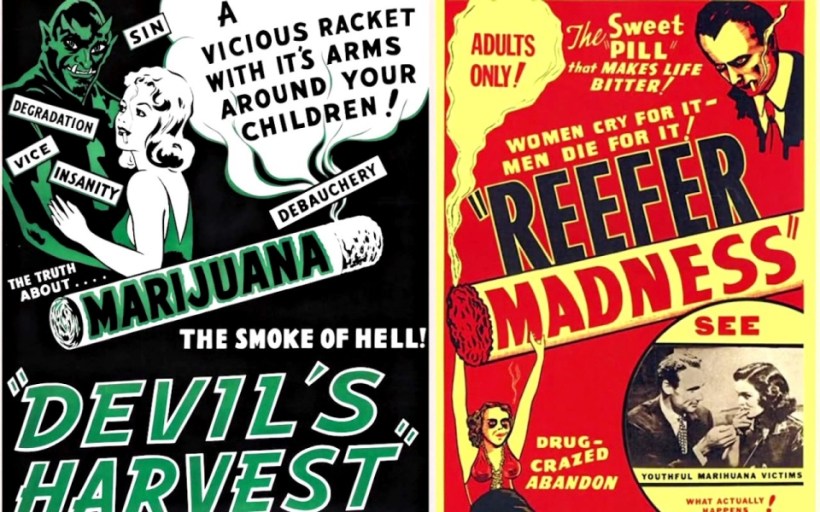
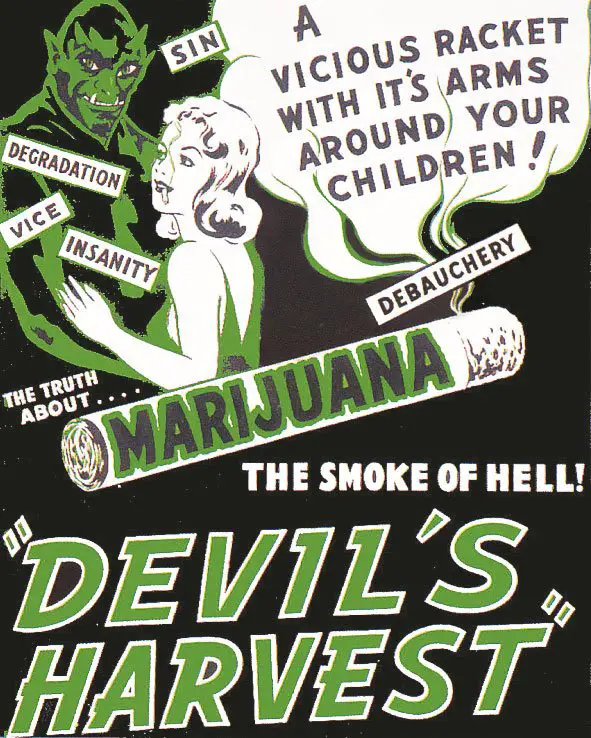
Dr. Gupta noted that the infamous Reefer Madness documentary was entirely funded by DuPont Chemical, and DuPont was heavily invested in nylon. In the 1930s, nylon was a new synthetic fiber that would’ve seen hemp fiber as direct competition. As in most facets of this country, profit was deemed more important than the well-being of the people, and the world itself. It is astounding that such a short time ago, this nation used cannabis to such an extent that farmers were actually fined if they chose not to grow it. Yet today, children and adults alike are taught that its properties are not only harmful, but deadly. For the first time in over a hundred years, people are beginning to see through the cloud of lies that have surrounded this plant.
Related reading: Marijuana Movement on a Legal Roll Worldwide – But Still Singing The Reefer Blues
This is the most shockingly absurd, yet most commonly used myth stated by government officials when advocating marijuana’s prohibition. Despite the many compilations of valid studies conducted by respected institutions, that prove, not only the efficacy of medical marijuana but its ability to cure cancer, the government continues to look the other way.
In 1999 The Food and Drug Administration stated that “no sound scientific studies” supported the medical use of marijuana, which contradicted the recent findings submitted by a panel of highly regarded scientists. Researchers have been attempting to speak out about this topic for over a decade yet the government simply chooses to ignore their findings. When citizens protest that cannabis should be allowed, at least in a medical capacity, the public is told that not enough research has been done. It is a game of misdirection that has been perfected by the government for over 70 years, however, the people are beginning to see through the facade, to the cover up behind it.
After Nixon declared marijuana enemy number one in the early 1970’s there was a massive and discreet effort to erase all evidence of its value. In just a few decades, the U.S. government was able to wipe thousands of years of anecdotal as well as solid scientific evidence of the efficacy of cannabis in treating a wide range of ailments and diseases from our collective medical knowledge.
“There’s actual documentation that shows the United States Government under Nixon was actively writing to universities saying ‘pull your information of cannabis, hemp and marijuana out of your libraries, literally purge it.” Todd McCormick – Researcher, Editor of “The Emperor Wears No Cloths”
Americans have been taught over the years that cancer has no cure. There have been studies that show a chemical that is in both celery and parley have the ability to effectively combat breast cancer. So why is this not public knowledge? Sadly, because there is no money in curing. Chemotherapy is the current go-to treatment of cancer despite the fact that is has a success rate of just under 3 percent. Chemotherapeutic drugs are the only classification of drug that allows the prescribing doctor to get a direct cut of the profit from their sale. The system is designed so that those in the position to change the system do not desire a change. There is just too much money being made.
Related reading: The Truth About Chemotherapy – History, Effects and Natural Alternatives
With one in every four americans expected to die of cancer this year (the newest numbers are now closer to 1 in every 2), it is more important now than ever before, that the miraculous healing properties of cannabis be made available to the many in desperate need. Even if cannabis did not hold the answer to what a desperate father needs for a dying child, what right does anyone have to tell a man he cannot do whatever is within his power to attempt to save his children. It becomes obvious that there are hidden motives when the government holds a patent for use of the very medicine for which thousands have been incarcerated. Yet the government still openly denies that marijuana has any medical value.

How can government officials have a patent for the medical use of cannabis, yet turn around and prosecute a mother like Angela Brown, who is using the plant in the manner in which the government patent acknowledges as legitimate? Her only crime was actually curing her son with a substance medically patented by her accusers. There are numerous accounts of American citizens publicly announcing that cannabis cured a family member of cancer, as well as many other ailments.
Adam Koessler is currently facing criminal charges, and was denied visitation of his two-year old daughter, for using NON-psychoactive CBD oil in an attempt to cure her of cancer, after he was told modern medicine could do no more. The family saw immediate and dramatic improvements until the government stepped in and discontinued the treatment, charging the father with possession and administering a dangerous drug to a minor. Her cancer went into remission with the small amount of CBD that was used, and now, can’t be found anywhere else in her body. Imagine what could have been done with continued treatment.
The shocking reality is that countless Americans are speaking out about the miraculous healing properties of cannabis, yet the Federal Government, knowing this to be true, blatantly denies it. Ask yourself why those with the ability to end so much suffering would choose not to. What industry stands to lose the most to a cure-all medicine that can be grown instead of prescribed? It is easy to cast aside information that contradicts what one has thought to be true since childhood. It takes courage to challenge one’s beliefs and open one’s mind to different ideas. Below are compilations of a combined 64 studies that prove cannabis is an effective treatment for cancer and in many cases, the cure. Those who aim to keep cannabis and its medical properties restricted will attempt to hinder the spread of facts such as these, but the secret is out, and the truth is spreading.
Related reading: Over 100 Scientific Studies Agree: Cannabis Annihilates Cancer
MYTH #5 – MARIJUANA LEADS TO HARDER DRUGS – “GATEWAY THEORY”
”While the gateway theory has enjoyed popular acceptance, scientists have always had their doubts. Our study shows that these doubts are justified.” – RAND’s Public Safety and Justice unit, 2002

One of the longest standing marijuana myths is that of the “gateway theory.” This is the theory that marijuana is considered a “gateway drug” which means its use will lead users, unintentionally and irrevocably, into the clutches of harder drugs. The reality is that this theory has been, time and again, disproved by just about every legitimate study conducted on the topic. It would seem that this concept is only alive today, due to its relentless revitalization by those intent on continuing marijuana prohibition. Yet, many continue to be swayed by its proclaimer’s continued focus on the only valid point in the argument: the correlation between marijuana use and harder drug use later in life.
The problem with using this correlation as the sole foundation on the argument of the “gateway theory” is that correlation is not cause. A great example given in Time Magazine elaborates on that statement:
“Hell’s Angels motorcycle gang members are probably 104 times more likely (comparing to an earlier reference) to have ridden a bicycle as a kid than those who don’t become Hell’s Angels, but that doesn’t mean that riding a two-wheeler is a “gateway” to joining a motorcycle gang. It simply means that most people ride bikes and the kind of people who don’t are highly unlikely to ever ride a motorcycle.”
Marijuana is the most commonly used drug in the United States. The most recent poll showed that 108 million people in America have tried marijuana. With that fact in mind, consider for a moment how easy it would be to show a correlation between any common practice and marijuana use. Most illicit drug users will likely have used marijuana in the course of their abuse simply because of the prevalence of marijuana. However, a study by the National Household Survey indicated that 79% of regular marijuana users do not use any other illicit drug. Nearly 85% of everybody in this country that uses any form of illicit substance whatsoever, uses solely marijuana. According to The National Cannabis Coalition:
“There are about 16.1 million monthly users of marijuana and only 287,000 monthly users of heroin. Not only do most people who try marijuana never move on to heroin, the vast majority of them don’t even continue smoking marijuana.”
This is the same conclusion that every legitimate study comes to when evaluating the validity of the “gateway theory.” Despite the fact that most illicit drug users have smoked marijuana, the vast majority of marijuana users have never used another illicit substance. Scientists long ago abandoned the idea that marijuana causes users to try other drugs. In a report commissioned by Congress to investigate the possible dangers of medical marijuana, the Institute of Medicine of the National Academy of Sciences wrote:
“Patterns in progression of drug use from adolescence to adulthood are strikingly regular. Because it is the most widely used illicit drug, marijuana is predictably the first illicit drug most people encounter. Not surprisingly, most users of other illicit drugs have used marijuana first. In fact, most drug users begin with alcohol and nicotine before marijuana — usually before they are of legal age.”
Research is beginning to suggest that focusing on marijuana as the key to preventing future drug abuse is like “closing the doors after the horses have already left the barn.” Marijuana use among adolescents appears to be a symptom of problem behavior, not a cause.
“There seems to be this idea that we can prevent later drug problems by making sure kids never smoke pot, but whether marijuana smokers go on to use other illicit drugs depends more on social factors like being exposed to stress and being unemployed – not so much whether they smoked a joint in the eighth grade.” -Dr. Karen Van Gundy, associate professor of sociology
People make their choices day-to-day based on a combination of reaction, desire and necessity. It is becoming clear that the usual precursor of potential drug use in adolescence is in fact instability, stress and violence in their life. These, along with alcohol and cigarettes, have been shown to be the true “gateway” into future illicit drug use. However, the idea that any one interaction can set a person on an irreversible path of drug abuse, may be possible, but a little far-fetched. It is interesting how the correlation between alcohol or cigarettes, and illicit drug use, is a much higher number than that of marijuana. Alcohol and cigarettes can cause much more damage to the body, yet it is marijuana that takes the focus, ask yourself why that is. Seventy one percent of illicit drug users smoke cigarettes and 17.6 million people, or one in every 12, suffer from alcohol abuse or dependence. Alcohol is the most commonly used addictive substance in the U.S.
The idea of a “gateway theory” in and of itself is a concept with little factual stability that refuses to die, lingering from the days of “Reefer Madness” and sensationalist claims when there was no internet to quickly dispel them. It is a way for people to place the blame of their poor decisions onto a substance that cannot answer back. To place the guilt on the evil plant that “made them do it.” Despite the years of factual evidence disproving the idea of this theory, government officials continue to make claims to the evils of the “gateway” drug, marijuana. These myths will only dissipate if the public educates themselves and chooses to speak out against the unfounded claims. One can hope, that as more studies draw attention to the archaic and misguided ideas once held about this plant, that the truth will find its way into the minds of even the most dedicated anti-marijuana crusaders. One more myth: debunked.
MYTH #6 – MARIJUANA CAUSES MEMORY LOSS AND A GENERAL REDUCTION IN LOGIC

From the original Jeff Spicoli to everyone’s favorite burger seeking duo Harold and Kumar, the idea of the lazy and forgetful marijuana smoker is a stereotype that has been embraced by cannabis culture and prohibitionists alike. One would be hard pressed to find a recreational cannabis smoker that hadn’t experienced some level of forgetfulness associated with marijuana. That being said, it is important to understand the reality behind this comical image of absent-mindedness.
Of all the stigmas associated with cannabis consumption, the idea of memory loss has the least amount of long-term studies. On that basis alone one must consider the possibility that the entire discussion could change as future studies come into light. Until that time all one has to go on is the research that has been done to date. To fully understand the effects of any substance on one’s memory, it is important to understand how one’s memory works.
Everyone has three different forms of memory, which are: long-term memory, short-term memory and working memory. This is quite an over simplification of the incredibly intricate workings of the human brain but works for the purposes of this discussion. Long-term memory is a vast store of knowledge and a record of prior events that each person builds throughout their lives. Short-term memory is the brain’s ability to recall ideas and information that pertain to a current situations that have yet to be formed into long-term memories. Working memory is not completely distinct from short-term. It is used to plan and carry out behavior. One relies on working memory to retain the partial results while solving an arithmetic problem without paper.
The first and most important distinction to make when discussing marijuana’s effects on memory is the very big difference between the effectiveness of memory recall while under the influence of cannabis and while sober. Marijuana has been shown to affect short-term memory and one’s ability to form new memories while under the influence, however, has little to no effect on one’s ability to recall memories formed before or after. In other words marijuana does not harm one’s long-term memories but makes it more difficult to retain information while intoxicated. Many feel that alcohol causes much more impairment on short-term and long-term memory, and its effects are not limited to the time of impairment, but cause lasting detriment to the memory.
A study following nearly 2000 young Australian adults for eight years found that marijuana has little long-term effect on learning and memory, and any cognitive damage that does occur as a result of cannabis use is reversible. Participants were aged 20-24 at the start of the study, which was part of a larger project on community health. Researchers categorized them as light, heavy, former or non-users of cannabis based on their answers to questions about marijuana habits.
“The adverse impacts of cannabis use on cognitive functions either appear to be related to pre-existing factors or are reversible in this community cohort even after potentially extended periods of use.” – Robert Tait at the Centre for Mental Health Research at Australian National University
As with any substance, using marijuana in excess can cause side effects. However minimal, one who chooses to be under the influence of marijuana twenty-four hours a day will experience some loss in cognitive function. Comparatively, one who chooses to be under the influence of alcohol twenty-four hours a day will most likely shorten their life substantially and have quite a bit more than a loss of brain function. A study conducted by Harvard Medical School shows that even this type of excessive marijuana use and consequent perceived harm is completely reversible. If and when one chooses to discontinue the excessive use, the brain function will return to normal. This in itself disproves years of marijuana propaganda. All one must do is take a break, and all negative memory associated effects are reversed, assuming there are any in the first place.
Published in a March issue of Addiction Biology, a team of Dutch scientists found no changes in the working memory abilities of heavy cannabis users who were monitored for three years. The study “adds to the literature showing that regular cannabis use may not necessarily impair brain functioning,” explains lead author Janna Cousijn, PhD, a researcher at the University of Amsterdam’s Department of Developmental Psychology. Working memory plays a key role in learning. Dr. Cousijn and her colleagues conducted the study on 49 young adults, 22 who were considered heavy cannabis users and consumed marijuana five days a week on average. This study shows that cannabis does not impair problem solving or deductive logic using working memory. However, recent articles have been circulating that claim contradictory findings.
There have been many articles recently released showing a new study proclaiming that marijuana causes irreversible damage to one’s memory and brain function. What is consistently skipped over in many of these articles is the fact that this study was conducted on adolescent use. Use of any substance, be it alcohol, tobacco, or even caffeine can have lasting effects on a developing brain, so it becomes quite irrelevant to make the focus on the effects of marijuana versus any other recreational substance. A vast majority of those shown to have negative effects attributed to long-term marijuana use, have a substantial correlation to those who started at a young age. Therefore the majority of those effects can be attributed to the use of a mind altering substance with a developing brain, whether it be cannabis or any other.
The truth of this topic, clouded by years of misinformation, can be hard to decipher. Relying solely on science and the conclusive information that the studies conducted have produced, it becomes quite clear that the idea of the classic stoner that can barely function due to marijuana use, is vastly overstated. One’s short-term memory can be affected while under the influence, but no real lasting cognitive side-effects are associated with marijuana, outside the category of adolescent use of any impairing substance. It is becoming clear that many of the most ingrained stigmas associated with this plant are exaggerated, if not completely made up. This myth has elements of truth to it, but overall, the idea that marijuana will leave you a mindless and dysfunctional human being is busted.
MYTH #7 – THERE ARE OVER 400 CHEMICALS IN MARIJUANA – TRUE!
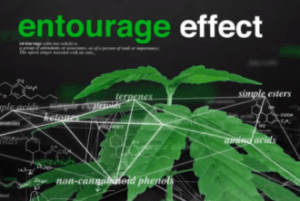
It’s true, there are over 400 chemicals in marijuana. So let’s look a little deeper…
The perception of cannabis as an evil and utterly useless drug began, as most things do, because of money and a potential loss of profit. Since the moment hemp was seen as a threat to the wrong men’s pocket books, every American has had a fabricated perception of cannabis forced into their daily lives to insure industries like timber, oil, synthetic fabrics and pharmaceuticals never have to compete with a vastly superior product. The fantastically inaccurate slander campaign being waged on this plant has not only hurt the image of cannabis and its potential industry, but stopped the age of innovation this country had been riding and sent Americans into an age of complacency and self-delusion.
One of the many statements that are commonly used to continue this campaign of false information is that cannabis contains hundreds of chemicals, as if implying, or rather letting the public assume, that those chemicals are inherently unsafe. This is a tactic often used by those attempting to lead the public astray; it is designed to make the average citizen believe that any item with that many chemicals must be unsafe for human use, when the reality is that roasted coffee contains over 1500 chemicals. Only 21 of those chemicals have actually been tested on animals and 16 of these cause cancer in rodents. Yet, coffee remains legal and is generally considered safe.
This is an outright dishonest attempt to confuse the public; to state a fact, knowing that Americans do not have all the information, that will lead the people to believe the only reason the government would give the information is because it is unsafe, when in fact many safe and commonly used items have just as many chemicals. This misleading statistic is often used to make marijuana look dangerous. Cigarettes contain over 4000 chemicals while rat poison contains only 30. One can easily see how this information can be misleading.
A recent study in the journal Scientific Reports showed that alcohol is an astounding 114 times more dangerous to consume than cannabis. When considering that an alcohol such as vodka has far less chemicals than cannabis, coffee or cigarettes, yet annually kills more than the first two combined, it becomes quite clear that alcohol is the most dangerous substance despite this country’s inability to acknowledge its detrimental effects. The researchers involved in the study commented:
“The results confirm that the risk of cannabis may have been overestimated in the past. At least for the endpoint of mortality, the margin of exposure for THC/cannabis in both individual and population-based assessments would be above safety thresholds. In contrast, the risk of alcohol may have been commonly underestimated.”
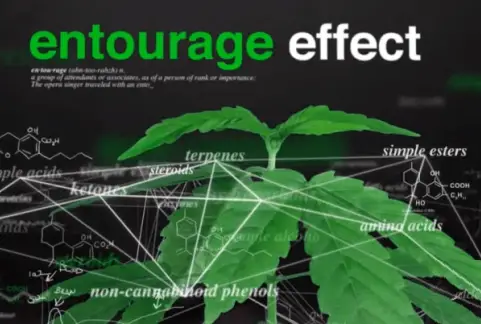
The different chemicals in cannabis — many of them medicinal and nutritional — have been extensively researched yet continue to be unacknowledged so government officials can continue to claim that not enough research has been done. Many officials would have Americans believe that the supposed “unknown” effects of the many chemicals in cannabis make the substance unsafe, and use this as a selling point to plug the government’s own cannabis alternative Marinol (a product that is in direct contradiction with the government’s continued stance that cannabis has no medical value). Marinol is a prescription drug that contains pure synthetic THC. It was approved by the FDA in 1985 for treating the side effects of chemotherapy. However, many doctors and patients have come to find Marinol a poor substitute for cannabis. This is due in large part to what’s called marijuana’s “entourage effect”, as CNN’s Dr. Sanjay Gupta explains:
“When the drug became available in the mid 1980s, scientists thought it would have the same effect as the whole cannabis plant. But it soon became clear that most patients preferred using the whole plant to taking Marinol. Researchers began to realize that other components, such as CBD, might have a larger role than previously realized.”
The “entourage effect” is the term for how the different chemicals in cannabis work together to create astounding healing and regenerative effects when taken unadulterated. The compounds have a very unique way of working in unison to aid the human body. When one individual chemical is taken out, as with Marinol, this “entourage effect” is lost. The human body is made with a naturally occurring endocannabinoid system that is designed to utilize the many different cannabinoids within cannabis collectively. This entourage effect and its multitude of healing possibilities has been stripped away from the public for so long that this country has seen the resulting digression of American’s overall health.
Related reading: The Endocannabinoid System and How THC Kills Cancer
It is becoming painfully clear to most that this plant has been, and continues to be, the focus of a massive propaganda campaign. Yet there are many who still have yet to see the falsity of the anti-marijuana age, or hold on to the naive belief that the government has only the people’s best interest in mind. Either way, this myth is actually true, but is the product of manipulation and is being used to confuse the average citizen into believing that “evil chemicals” in this demonized plant will jump out of one’s closet at night and eat your children, or something just as ridiculously untrue. All one can do is stay vigilant and continue to spread the truth. This battle is being won, yet the war has only just begun.
MYTH #8 – MARIJUANA HAS YET TO BE SUBJECTED TO ADEQUATE SCIENTIFIC STUDY

Of all the misinformation continuing to circulate around the issue of marijuana legalization, this myth is by far the most absurdly incorrect. The most unsettling aspect of these myths is not that they exist, rather that those still proclaiming them as truth are acutely aware of their falsity. This is also called blatantly lying. How can any American truly trust their elected officials after a campaign as massive, deceitful and all-encompassing as this country’s 80 year war on marijuana? When one who is meant to embody the essence of the democratic process claims that not enough studies have been done involving cannabis, yet the proof is easily accessible, what is one to think? Children are dying, cancer patients are withering away, and those charged with the people’s well being are lying about the cure to protect their profits.
It can be quite hard for many to accept the fact that they have been lied to by the very leaders in which Americans are meant to put their faith. These men may very well have had reasons they felt were justified, or acted out of some misguided intention of protection. One can understand that action if not condone it. However, in this stage of the debate, all the pertinent information is up front and center, and for anyone to claim that the data is not there, is outright laughable.
Related reading: Cannabis as Medicine: How CBD (Cannabidiol) Benefits the Brain and Nervous System
Cannabis has had a longer history of safe and effective use as a therapeutic agent than virtually any comparable substance. Cannabis based textiles have been identified in northern China dating back to 7000 B.C and the recognition and use of the plant’s medicinal abilities date back almost as far. Cannabis has been used in this country as an all-purpose fabric, oil, paper and medicine until the early to mid nineteen hundreds when it began to compete with the leading industries that were primarily run by the country’s ruling families. The general acceptance and use of this plant in American history does not scientifically prove it to be safe, but does show that the continued use over the last 500 years hasn’t had the devastating effects that today’s government would have the people believe will break out across the country when the plant is legalized. The scientific studies came after the illegalization of the plant, and some of them date farther back than many realize.
Despite the claims of politicians, marijuana is one of the most studied biologically active substances of modern times. A search on PubMed, the repository for all peer-reviewed scientific papers, using the term “marijuana” will produce nearly 20,000 scientific papers referencing the plant. Nearly half of these studies have been published just within the past decade. There can be no doubt that officials are aware of these studies, especially when marijuana has become such a politically charged issue. By comparison, a keyword search using the term “Tylenol” yields 17,370 published papers. A keyword search using the term “ibuprofen” yields 10,500 published paper. A keyword search using the term “Ritalin” yields 7,012 published papers, and a keyword search using the term “hydrocodone” yields only 630 published papers.
Some might also claim that there aren’t sufficient clinical trials, versus scientific studies, evaluating marijuana’s safety and efficacy as a medicine; which is also dramatically incorrect. More than 100 controlled trials, involving thousands of participants, have tested and evaluated the safety and efficacy of cannabis. Most recently, a review of FDA-approved cannabis trials conducted by various California Universities concluded,
“Based on evidence currently available the Schedule I classification (for cannabis) is not tenable; it is not accurate that cannabis has no medical value, or that information on safety is lacking.”
This body of clinical evidence exceeds that of many FDA-approved prescription drugs. According to a 2014 review published in the Journal of the American Medical Association, of the 188 novel therapeutic agents approved by the FDA between the years 2005 to 2012, “The median number of pivotal trials per indication was two, and 74
indications (37%) were approved on the basis of a single trial.” Drugs that stand to increase profit for the pharmaceutical industry are fast-tracked into public use, apparently whether or not the drug is adequately tested, and even if it takes a few lives during the evaluation process.
The FDA recently approved a new super-Vicodin type drug called Zohydro. This drug contains up to five times the amount of hydrocodone and does not have time-release protection, so it can be easily crushed up and snorted or injected by those who would abuse it. This drug was approved after only one twelve-week trial in which five of the people involved died as a result. Yet cannabis, which has been widely used in all facets of American life for centuries (until the last hundred years) with zero deaths, is dangerous and unlawful in the eyes of the Feds. This is the very definition of hypocrisy.
“When you talk to pain specialists in our field, they will all tell you one indisputable fact: opiates are lousy drugs to treat chronic pain” said one FDA committee member who voted against Zohydro approval
Numerous medical and health organizations – such as the American Nurses Association, the American Public Health Association, and the Epilepsy Foundation of America – support allowing qualified patients to legally access to cannabis therapy. According to survey data released this year by WebMD/Medscape, nearly 70 percent of doctors, including over 80 percent of oncologists and hematologists, acknowledge the therapeutic qualities of cannabis. More than 50 percent of doctors agree that it should be a legal option for patients and 76 percent of doctors would recommend cannabis to their patients despite it being Federally illegal.
There can be no doubt that this myth is indeed false. The question each American must ask themselves is why does the government continue to lie when the truth is so clearly documented? What do they stand to gain? What in American culture is so sought after that it would cause the leaders of this country to stand before the nation and intentionally dismantle the perception of the most versatile, medically and industrially useful plant the world has ever known? It’s the same answer to all the whys behind every political deception: Money.
Related reading: Over 100 Scientific Studies Agree: Cannabis Annihilates Cancer
MYTH # 9 – THE MARIJUANA MOVEMENT IS JUST AN EXCUSE FOR PEOPLE TO GET HIGH

At one very prosperous and advantageous point is this country’s history, hemp was beginning to be recognized as the future in textiles, food, medicine, fuel and just about every other important necessity of today. In 1916, the U.S. Government predicted that by the 1940s all paper would come from hemp and that no more trees would need to be cut down. Government studies report that 1 acre of hemp equals 4.1 acres of trees. In 1938, hemp was called the ‘Billion Dollar Crop.’ It was the first time a cash crop had a business potential to exceed a billion dollars. The simple profitability and versatility of this plant greatly threatened those who’s fortunes were tied to all that hemp stood to replace; primarily the Hearst family and Dupont Industries and their mutual investment in the prosperity of timber and synthetics, both of which were dramatically outmatched by what hemp was producing. Due to the fact that hemp was widely regarded as the plant of the future, those set on destroying hemp had to find a way to purposefully and discreetly mislead the public. Thus began the all-out war against hemp disguised as a war on the Mexican ‘marihuana.’
Americans pride themselves on the simple freedom of one’s right to choose. Yet in today’s America, this seems a slowly dissolving right as the government continues to increase the number of things they deem illegal; for one’s own safety of course. The Last American Vagabond wholeheartedly fights for the right of each individual to do whatever one deems necessary to one’s own body, whether that be smoking marijuana or drinking something proven as deadly as alcohol. However, that is only one small part of what defines the Marijuana Movement and its goals.
The movement was started as a public outcry against the government’s encroachment on all personal freedoms in this country, and centered around one issue in particular: marijuana legalization. This focus was chosen because, along with legalization, it ties all current constitutional issues together under a banner that ultimately represents the gravest issues facing this country today: loss of civil rights, government misconduct and misappropriations, and a century long conspiracy, of which is slowly becoming public knowledge; as well as uniting two vastly different generations under one flag.
The idea that plants as useful and medically valuable as hemp and marijuana are not only illegal but regarded as the most dangerous of all drugs, is laughably absurd. Americans are awakening to the sad truth that they have been intentionally lied to for a generation about a plant that could have saved the lives of many, in order to protect the investments of a few. A point has been reached in this country where it seems as if the will of the people is no longer what decides the course and creation of law, but rather the needs and desires of whatever cooperation spends the most money, which by definition would make the U.S. no longer a democracy.
Those behind the movement are using the platform of cannabis legalization to stage a national intervention in regards to the people’s rightful place as the governing body of this nation. If the leaders of this country can tell the American people that they know what is best, despite the overwhelming agreement on the issue of legalization, then this country has truly forgotten itself. Those in power want the public to believe that cannabis remains illegal not because it stands to replace the vast amount of the fuel and pharmaceutical industries, which a majority of the top one percent of this country are invested in, but because it’s dangerous, despite the overwhelming amount of evidence to the contrary.
The right of each individual to consume whatever substance they desire in the privacy of their own home is certainly a part of this debate. Yet the true fight is centered on whether the true governing body of this country remains a small percentage of wealthy men (ones that represent the smallest demographic of Americans) or We the People of the United States of America, the decision is yours.
Related reading: What’s Really Going On Under the Hood of the Cannabis Movement: “Big Marijuana”, GMOs and Hemp
MYTH #10 – OPPOSITION TO MARIJUANA LEGALIZATION IS DRIVEN ENTIRELY BY CAUTIOUS PRUDENCE

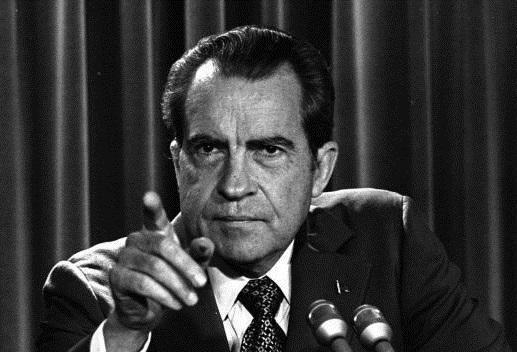
On an ominous June day in 1971, President Richard Nixon declared to the public that drug abuse was now “public enemy number one.” With this one statement he would irrevocably change the course of the nation by laying the foundation for a reign of unprecedented political misappropriation and corruption all in the name of the “War on Drugs” or more accurately the “War on Marijuana.”
The War on Drugs began as corrupt as it is currently today; a war with no possible end that promotes profiteering on the backs of those who desperately need the help of the very men profiting on their demise. This “war” was declared on all drugs, yet one in particular had caught the attention of some prominent American families and businessmen due to its ability to render their products obsolete. Marijuana’s versatility in the medical and industrial field played a major role in the creation of this policy. Whether or not the Nixon administration fully understood what they were creating with this declaration, there can be no doubt that the group had a clear understanding of the policy’s political and societal ramifications and what that would mean for current and future politicians in the United States. By effectively criminalizing addiction, addicts became potential profit in the eyes of the system.
“Attorney General Kleindienst for Nixon, was quoted after Nixon declared Drugs ‘public enemy number one’ as saying that they knew in the Nixon administration that drug treatment worked and incarceration did not, but the enormous political benefit by declaring a war on drugs, that can’t really fight back, he said they chose the incarceration route for political reasons, and then were absolutely overwhelmed by the positive political benefits that they received after the declaration.” -Judge Jim Gray – Former Orange County Supreme Court Judge
Once you make it profitable to incarcerate people; once you give people a profit motive to put others in prison, you change the fundamental process of the justice system into a process of profit and loss. These are people’s lives, and shouldn’t be a company’s bottom line. This dynamic incentivizes those in charge to incarcerate or maintain incarceration, whether or not it’s justified, solely to maintain profitability. These prisons have a contract to maintain 80% capacity at a minimum, crime could go down and it wouldn’t matter, their quota must be met. In California since 1980, 20 prisons were built, 14,000 prison guards were hired and 5000 teachers were fired.Prisons have become a billion dollar industry that are largely fueled by this nation’s fight against marijuana.
![]() http://www.globalresearch.ca/the-secret-war-in-libya/5365906
http://www.globalresearch.ca/the-secret-war-in-libya/5365906
” data-medium-file=”” data-large-file=”” class=”alignleft wp-image-2445 ” src=”https://i2.wp.com/www.thelastamericanvagabond.com/wp-content/uploads/2015/09/solved-murder-nixon.jpg?resize=229%2C300″ alt=”marijuana” srcset=”https://i2.wp.com/www.thelastamericanvagabond.com/wp-content/uploads/2015/09/solved-murder-nixon.jpg?resize=229%2C300&zoom=2 1.5x” scale=”1.5″ height=”262″ width=”200″>Over 2 million adults are currently incarcerated in the United States, that’s the highest incarceration rate in the world, and over 30% of that is for marijuana possession. In the 1.5 million arrests on drug related offenses in 2011, about 50% were for marijuana use. In 1965, police were solving about 90% of the murders in this country. Today that’s under 65%, and that’s considering all the tremendous advances in technology, DNA evidence, etc. The focus has clearly shifted. Without the ever-increasing conviction for petty marijuana related crimes, these prisons would fail to meet their quotas and their entire business model would collapse. For this reason amongst many, this industry is on the forefront of maintaining the war on marijuana.Related reading: The War On Drugs: How the “Land of the Free” Became the “Home of the Slaves” for 2.3 Million Americans
Americans have begun awakening to the massive collusion that surrounds the legality of this plant. This corruption has bled into every aspect of government that deals with marijuana for the sole purpose of maintaining its schedule I status, at all costs. The group that stands to perceivably lose the most with the legalization of marijuana would be the pharmaceutical industry. One would think that the discovery of a new ground-breaking medicine that heals just about everything would be exactly what those in the business of medicine would want. Unfortunately, Big Pharma got out of the curing business a long time ago. All of its efforts have gone into creating a perpetual cycle of treatment, because there is no money in curing.
Most of the major groups fighting to keep marijuana perceived as the most deadly drug known to man, just so happen to be funded by companies that stand to lose money with the rise of an all-natural medicine that can be grown in one’s back yard. These groups preach from on high about the moral and compassionate reasons for opposing legalization when in reality the greedy Big Pharma is pulling all the strings. The Community Anti-Drug Coalition of America (CADCA) and the other groups leading the fight against relaxing marijuana laws, including the Partnership for Drug-Free Kids (formerly the Partnership for a Drug-Free America), derive a significant portion of their budget from opioid manufacturers and other pharmaceutical companies.
The Nation obtained a confidential financial disclosure from the Partnership for Drug-Free Kids showing that the group’s largest donors include Purdue Pharma, the manufacturer of OxyContin, and Abbott Laboratories, maker of the opioid Vicodin. CADCA also counts Purdue Pharma as a major supporter, as well as Alkermes, the maker of a powerful and extremely controversial new painkiller called Zohydro. The drug, which was released to the public in March, has sparked a nationwide protest, since Zohydro is reportedly ten times stronger than OxyContin. Janssen Pharmaceutical, a Johnson & Johnson subsidiary that produces the painkiller Nucynta, and Pfizer, which manufactures several opioid products, are also CADCA sponsors. With primary financial backing that stand to lose billions, it is clear where the motivation comes from.
Related reading: Big Pharma and Organized Crime — They Are More Similar Than You May Think
There are many who undoubtedly believe wholeheartedly that marijuana is the worst substance on the planet. This most definitely derives from the 70 year smear campaign designed to instill just that type of fear. It is unfortunate that many have yet to see the light in regards to marijuana’s curing properties; even more so unfortunate that those very same individuals are being manipulated into fighting a war for an elite group with no one’s interest in mind except their own.
From the prison industry, to the pharmaceutical industry, to the timber industry, billions of dollars are being thrown at the failing marijuana war in an attempt to maintain the facade of a evil drug that will corrupt your children and ruin your life. This however is a remanent of a time before the internet; a time when the government could be caught in a lie and there was time to secretly hide the evidence. That time has come to an end. When one hears, many hear. When one sees, we all see.
Follow the change. Be the change.
Also see: Still Believe Nature Got It Wrong? The Top 10 Health Benefits of Marijuana
About the author:
Driven by a desire for accuracy, chef and alternative news stalwart Ryan Cristián has a passion for the Truth. As founder and Editor-in-chief of The Last American Vagabond, he understands that Americans want their news to be transparent, devoid of the opulence frothed out by today’s Corporate Media. A cultured and insightful man with a worldly sense, Ryan’s unjaded approach offers common sense to the individual racked by the ambiguous news cycle – a vicious and manipulative merry-go-round that keeps trenchant minds at a manageable distance from the truth. Avid writer and editor by day, Truth seeker by night, Ryan’s reality defines what it means to be current.
“Living is easy with eyes closed, misunderstanding all you see.” – John Lennon
http://wakeup-world.com/2016/11/06/debunked-10-myths-about-arijuana-that-no-one-should-believe-and-why/





 Oro Cas Reflects


You must be logged in to post a comment.